
Understand your database's structure. Never hand over its data.
SSDO reads the structure of your database (tables, columns, keys, links), explains it in plain language, watches it change while your team codes, and tells you what a change will affect before you run it. It never reads a row.
Try it free No card, no real database needed: start with a sample
Try SSDO Instantly With Demo Credentials
Visitors and engineering teams can test-drive SSDO immediately without connecting a database or creating an account. Click any demo workspace below to launch it with one click, or use the visible credentials to sign in.
Solunex Dev Lab (Demo)
Full technical detail, live watches, schema compare, App Simulation and code generation.
demo.dev@solunex.test
demo_dev
solunex-demo-2026
Solunex Academy (Demo)
Guided lessons, interactive checks, practice databases, classes and the SAS Lab.
demo.academy@solunex.test
demo_academy
solunex-demo-2026
Kano Microfinance Bank (Demo)
Verified organisation, approved database registry, Governance, Change Control and Environments.
demo.enterprise@solunex.test
demo_enterprise
solunex-demo-2026
Watch SSDO in Action: 2-Minute Architecture Tour
See how SSDO profiles live schemas, detects breaking migration drift, and bridges AI coding agents — without reading a single customer row.
Interactive Platform Screen Walkthrough
Explore every screen and navigation capability inside SSDO.
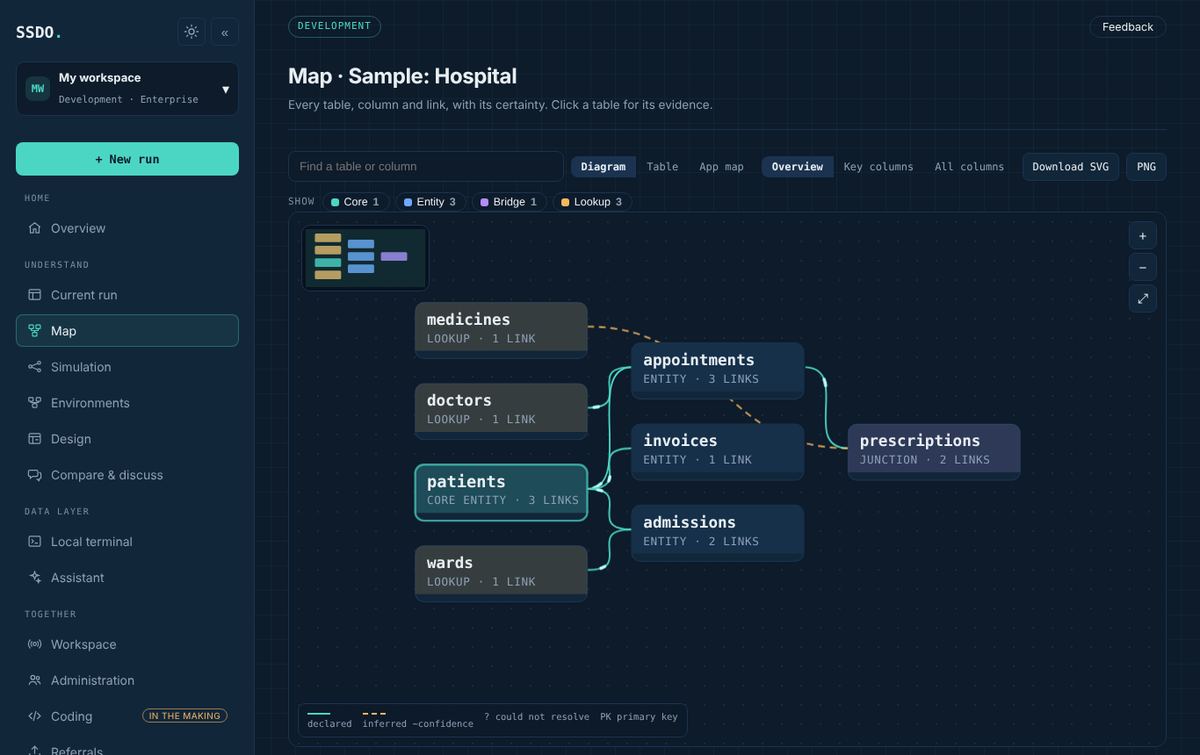
- Interactive ERD & Inferred Link Engine: Solid green lines denote verified database foreign keys; dashed amber lines highlight inferred joins (
user_id→users.id) with confidence scores. - Zero Row Exposure Invariant: Visualizes complete relational graphs and table dependencies without transmitting a single customer data row.
- Real-Time CLI Watcher:
ssdo watchstreams schema modifications as developers code, proposing safe migrations with terminal confirmation. - App Simulation & Insert Cascades: Predicts topological insert ordering and prevents orphan cascading delete deadlocks before code merges.
- Automated Code & ORM Generation: Instantly converts any SQL database into production-ready Prisma schemas, TypeScript interfaces, SQLAlchemy 2.0 models, Go structs, and Django models.
- AI Agent Gateway (MCP Server): Safely connects Claude Desktop, Cursor, and Windsurf to database structure with strict data isolation.
- SAS: Secure Access Sandbox: Controlled separate doorway for audited, masked query access with owner dual-approval signing.
- Academy & Hands-On Practice Labs: Explore real-world schema archetypes (E-Commerce, FinTech, Hospital Systems) with zero setup friction.
Start in 60 seconds
- Open a sample. Try the Online shop. No sign-up and no database of yours is needed: a sample holds only structure.
- Read the map. Each box is a table and each line is a link between tables. A solid line is declared by the database; a dashed line is SSDO's inference, with its evidence.
- Click a table to see its columns, or open the sample in the console to ask a question or simulate what must exist before one row can be written.
What it does
Live workspace
ssdo watch runs next to your code and shows each structure change the moment it happens, to you and the teammates you choose. Your database password never leaves your machine.
Review a change on paper
Write an ALTER TABLE and SSDO explains what changes and what depends on it, then writes it as an Alembic revision. Nothing is run until you type yes in your own terminal.
In your pull requests
A GitHub Action comments on each pull request with what the migration really does to the structure, and what needs care.
Ask about your database
“Which tables does orders depend on?” Answered from the structure, with every fact marked as declared or inferred, and what SSDO cannot know said plainly.
Works with your AI tools
ssdo context and a read-only MCP server let Claude Code, Gemini or ChatGPT see your structure, never your data. They can only propose: you decide.
Learn and coach
Academy mode for students and classes, and a room where an experienced mentor can review your work for a time you choose.
What a pull request comment looks like
This is real output from ssdo diff on two small snapshots.
SSDO · base → head · postgres
2 columns added, 1 column removed

  fact      Column customers.phone added (text).
  fact      Column orders.total_kobo added (bigint).
  fact      Column orders.total removed.

Needs care (2)
  ! [can_lose_values] Column orders.total is removed: whatever it holds is discarded.
    SSDO does not read data, so it cannot say whether it is empty.
  ! [can_fail_on_rows] New column orders.total_kobo is required (NOT NULL). If it has no default,
    adding it fails on a table that already has rows.

SSDO read only the structure of the two databases. No data was read.
Works with PostgreSQL, MySQL and MariaDB, Microsoft SQL Server, Oracle and SQLite. Reading, watching, comparing and explaining work on all of them; drafting, applying a change and writing Alembic revisions work on all of them except SQLite, which is read only.
Structure only: the promise
- SSDO reads table and column names, types, keys and links. It does not read rows, ever.
- Your database password is used once and never stored. Run
ssdo watchon your own machine and it never leaves it; if you use the Connect form instead, it goes to our server for that one read and is never stored or logged. Use a read-only account either way. - Every statement is marked as a fact the database declares, or an inference with its confidence. No hidden model decides what is true.
- For companies that need to touch data, a separate, gated product (SAS) answers approved questions with counts and masked lookups, with a tamper-evident audit trail. That is an Enterprise feature, kept apart from SSDO by design.
How Do You Feel While Visiting SSDO Today?
Your direct experience shapes what we build next. Tell the Solunex engineering team: How often would you visit? What excited you most while working? How do you feel? Is there anything bad or to upgrade?
🔥 Excited & Impressed 🤔 Curious · Still Exploring 🛠️ Found Something Bad / To Upgrade
SSDO IP & Codebase Buyout Dossier
The founder is divesting SSDO as a complete, production-grade turnkey asset for $9,500 USD closed securely via Escrow.com to consolidate engineering bandwidth onto other active ventures.
100% Turnkey Ownership
Full intellectual property, brand, copyright, private GitHub repository with entire commit history, and active Render cloud deployment (render.yaml).
Zero Customer Row Invariant
Architected around zero row access. Reads only information_schema and DDL structure, enabling safe deployment in enterprise/regulated environments.
14-Day Developer Handover
Includes 14 days of direct 1-on-1 developer onboarding with the founder, comprehensive 38-page technical manual, and all 46 specification documents.
Verified Codebase & Scale Metrics
Counted from the repository. Spec-first typed Python and modular vanilla JavaScript with zero build rot.
| Python backend | about 48,300 typed lines (FastAPI, SQLAlchemy 2, Pydantic 2) |
|---|---|
| JavaScript frontend | about 10,000 modular lines (zero framework dependencies) |
| Automated tests | 2,060+ passing tests across 151 suites |
| Database engines | 8 native profilers (Postgres, MySQL, SQL Server, Oracle, SQLite, Snowflake, BigQuery, DuckDB) |
| API routes | 373+ endpoints across 20 modules |
| Database tables | 84 relational tables, with 65 migrations |
| Relational capabilities | Column lineage, migration guardian, DDL importer, App Simulation |
| Written specifications | 46 architectural specs & 38-page manual |
Diligence & Transaction Safety
Transactions are closed securely through Escrow.com with milestone verification. Confidential demonstrations, staged source code review, and full diligence packs (specifications, dependency inventory, and architecture diagrams) are available under standard mutual NDA.
Who it is for
Developers and freelancers
Know a database you inherited, and change it without surprises.
Teams
See the same changes together, review migrations in pull requests, and keep an audit of who approved what.
Schools and bootcamps
Classes, assignments, grading and certificates anyone can verify.